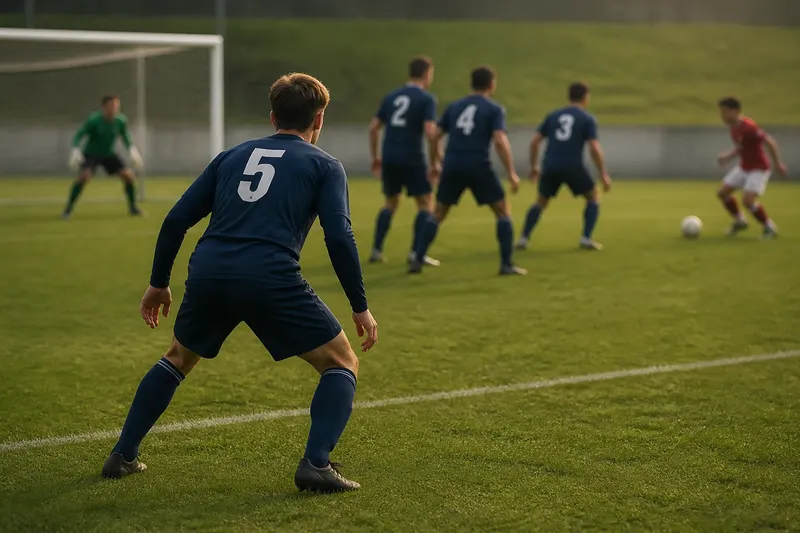
Man-to-Man or Zone Defence: What Each Assignment Follows
Man-to-man or zone defence becomes easier to read when you track defenders through cuts, screens and hand-offs, then identify the responsibility that persists.

Man-to-man or zone defence is easiest to identify when an attacker crosses the court or cuts behind a screen. Track the defender, not just the ball: does responsibility follow a particular opponent, or stay with a patch of space?
Read the assignment
In man-to-man defence, each defender is primarily responsible for an opposing player. The defender tracks that player’s position and tries to obstruct useful routes, passes or shots. The assignment can change after a screen, a switch or a tactical call, but an opponent remains the basic reference point.
In zone defence, defenders are responsible for areas of the playing surface. They watch for attackers entering those areas, then challenge, contain or pass them on as they move. A defender may mark someone closely for a moment, but the area—not that individual—is the underlying assignment.
Think of it like guarding a doorway rather than following a guest through a room. One defender tracks a person; the other protects a place. The useful question is what the defender keeps tracking as the play changes.
Track players and space
Choose an attacker moving away from the ball and watch the nearest defender. If that defender travels with the attacker across the court, it points towards player-focused coverage. If the defender stays near an area and a teammate takes responsibility as the attacker moves on, zone coverage is more likely.
Crossing routes offer another clue. In a straightforward man-to-man scheme, defenders may follow their assigned opponents as the attackers pass each other. In a zone, defenders are more likely to hold positions and let attackers move from one area to another. Neither clue settles the question alone: a man-to-man defender may switch, and a zone defender may follow an attacker briefly.
Notice where defenders look and how they adjust when the ball moves. A zone defender often checks the ball and several nearby attackers entering their area. A player-focused defender tends to stay oriented towards their assignment, while still watching the ball and screens.
Read screens and hand-offs
A screen tests how responsibilities work under pressure. In man-to-man coverage, the defender guarding the screened player may fight around the obstacle, ask a teammate to help, or switch opponents with that teammate. A switch is an exchange of player assignments, not an abandonment of responsibility.
In zone coverage, defenders organise around space rather than preserving one-to-one pairings. They may adjust their positions around a screen and pass an attacker to the next defender as that attacker enters another area. The clue is what happens afterwards: do defenders return to particular opponents, or reset their shape around space?
Say you are watching basketball. Imagine a wing attacker cuts through the key while a defender follows, then exchanges opponents with a teammate after a screen. That sequence points towards man-to-man with a switch. If defenders hold their positions, meet the cutter briefly and pass responsibility to the next area, it points towards zone coverage. Those observations suggest a pattern; they do not prove the whole possession uses only one scheme.
Allow for mixed coverage
Defences are not always tidy. A man-to-man defender may leave an assignment to help stop a drive, then recover when the danger passes. That temporary move does not turn the whole defence into a zone. Equally, a zone defender may stay tight to an attacker near the basket.
Teams can blend responsibilities. A coach may ask one defender to shadow a particular opponent while teammates protect areas. Other schemes begin in a zone, then match defenders to nearby attackers once the attack reaches a certain point. These are often called hybrid or match-up coverages, though terminology varies by sport and team.
To distinguish a temporary adjustment from a broader pattern, watch several possessions. Ask whether defenders repeatedly return to particular opponents or re-form around areas. A close pursuit or hand-off is a clue, not a verdict.
Questions about coverage?
Does a defender follow an attacker across the court?
Repeated pursuit across several areas supports a man-to-man reading, especially if the defender stays with the same opponent as the ball moves. Check what happens when the attacker leaves the area, since a zone defender may follow briefly too.
Who takes over when attackers cross?
If defenders exchange opponents at the crossing point, they may be switching man-to-man assignments. If one releases an attacker and another takes over as that attacker enters a new area, the pattern fits zone coverage more closely.
Where do defenders settle when the ball moves?
In man-to-man defence, defenders adjust in relation to their assignments as well as the ball. In a zone, their positions more visibly preserve coverage of particular spaces while attackers circulate.
Can one possession settle the question?
Usually not. A screen, drive or special assignment can make either scheme resemble the other for a moment, so compare repeated movements and hand-offs before deciding.
Check the pattern
Use these observations to make a cautious call. Each item names what to watch and how the result should shape your reading; if the evidence points both ways, keep the answer open and watch another possession.
- Track one attacker moving away from the ball: if the same defender follows across several areas, lean towards man-to-man; if the defender holds an area and a teammate takes over, lean towards zone.
- Watch attackers cross paths: if defenders cross with their original opponents, read that as evidence for man-to-man; if defenders stay in their areas and pass attackers on, lean towards zone.
- Follow a screened defender: if the defender fights around the screen or trades opponents with a teammate, consider man-to-man coverage; if teammates adjust around an area and pass the attacker along, consider zone.
- Notice a help defender: if they return to a specific opponent after the danger passes, count that as a man-to-man clue; if they reset to an area, count it as a zone clue.
- Check who receives a hand-off: if the same defender resumes responsibility after a brief exchange, consider a switch within man-to-man; if responsibility changes at the boundary between areas, consider zone.
- Compare several possessions: if the same opponent-focused pattern recurs, describe the defence as man-to-man; if area coverage recurs, describe it as zone. If both persist, call it mixed or match-up coverage rather than forcing a single label.
Compare what they protect
Man-to-man defence gives each attacker a clear opponent to account for, which can help defenders contest movement and passes directly. It also demands attention, communication around screens and help from teammates when an assignment is beaten.
Zone defence is organised to cover space collectively. It can crowd routes into a protected area and share responsibility for attackers moving through it. Openings may appear between areas, while a patient attack can try to move defenders out of position. The exact strengths and weaknesses depend on the sport and the shape used.
Neither approach is automatically better. The players, opponents, playing surface and match situation all matter. The label alone cannot tell you which team has the advantage.
Follow responsibility
To read man-to-man or zone defence, track responsibility through movement, crossings and screens. Player-focused coverage tends to preserve responsibility for opponents; area-focused coverage tends to pass attackers from one space to another. Mixed schemes blur the line, so look for the rule that recurs rather than naming a defence from one burst of movement.
When a defender leaves an opponent to help, wait for the next decision. Do they recover to that player, switch to someone else, or settle back into a shared area? That response often tells you more than the initial chase and gives you a sounder reading of the team’s defensive tactics.