Why a Boundary Is Part of the Game, Not Just Its Edge
A boundary defines where play counts, how outcomes are judged and which playing-area design best suits a game’s purpose and setting.
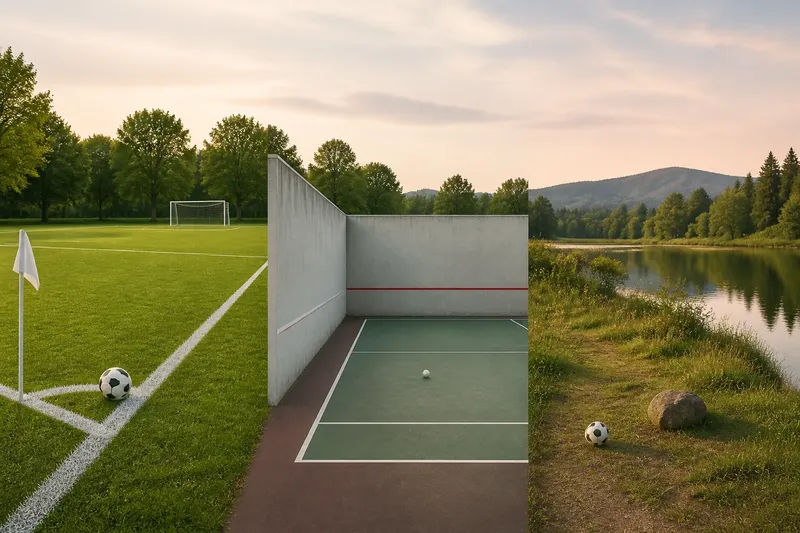
A boundary changes what counts as play, not merely where play stops. In any game with a marked area, the line, wall or edge helps decide whether an action belongs to the contest and what result follows. That makes the playing area part of the rules in visible form.
Different boundary designs suit different games and settings. A painted line gives players room beyond the playable space; a wall can keep a ball in motion; a natural edge may make the limit obvious but harder to mark precisely. Comparing these approaches shows why a boundary must be understood as a rule-bearing feature, rather than decoration around the action.
Space with consequences
A marked area does two jobs. It gives players a shared space in which to act, and it supplies a reference for judging events near its limits. A ball can cross a line, a player can step beyond it, or an object can land on one side rather than the other. The boundary helps turn those physical events into outcomes the participants can recognise.
The painted line itself is often treated as part of the playable area, though the exact convention depends on the sport. That distinction matters: a ball touching the line may count differently from one that has fully passed beyond it. The line is not always a narrow strip of neutral ground; its meaning comes from the rules attached to it.
Imagine a community game played on a rectangular patch of grass, with chalk marking its limits. If the rules say the chalk belongs to the field, a ball resting on it remains in play; if they define the field as the ground inside the chalk, that same resting ball is out. The grass has not changed, but the agreed boundary changes the call.
Painted lines
Paint, chalk, tape and other visible markings make a limit legible across an open surface. They suit games where players need to move freely near the edge and where a ball or player can cross a boundary without being stopped by a physical barrier. A line leaves the space open, which can be important when the surrounding area must remain accessible.
This approach works best when markings remain clear and the playing surface allows officials or players to judge contact with reasonable consistency. A faded stripe, loose tape or overlapping markings can blur the distinction between in and out. Good layout separates the relevant lines visually, while clear conventions explain whether the marking itself counts as part of the area.
Painted boundaries suit organised play on courts and pitches, and they can also adapt to temporary or shared spaces. The trade-off is that they mark a limit without physically enforcing it. Players and officials must interpret what happened at the edge, and the surrounding space needs to be safe for movement beyond the line.
Physical barriers
A wall, net or other barrier makes the limit tangible. It can stop or redirect an object, helping keep action within a contained space. In some games, contact with a wall is not the end of an exchange but part of how the game is played; in others, the barrier simply prevents equipment from travelling further. The same object can therefore be either a boundary feature or an active part of play, depending on the rules.
Barriers suit enclosed venues or activities designed around rebounds and close control of the playing space. They can make the edge easier to see, but they do not remove the need for rules: a game still needs to specify what happens when an object hits the barrier, passes over it or reaches a gap. The boundary is more concrete, yet its consequences remain defined by convention.
A barrier also takes up space and may affect how the playing area feels. Players have less room to continue beyond the marked limit, and the surrounding structure needs to suit the activity. So a wall is not simply a more visible line. It changes the relationship between the playable area and everything around it.
Natural edges
Some games use a natural feature, such as the edge of a clearing or a distinct change in terrain, to indicate where play ends. This can suit informal activity in a place where installing markings or barriers would be awkward. The landscape itself supplies the visual cue, and the boundary may be easy for participants to understand at a glance.
Natural edges become less useful when the transition is gradual or disputed. A patch of rough ground, a slope or a line of trees may look like a clear limit to one player and an imprecise one to another. If a game needs consistent calls, participants must agree where the edge lies and what crossing it means. A visible landmark is not automatically a precise rule.
This option is best for play where flexibility matters more than exact repetition, or where the terrain offers a distinct and stable edge. It suits a group willing to agree on the limit before play. Where the outcome depends closely on whether an object has crossed a narrow boundary, a marked or constructed limit may be easier to interpret.
Choosing a boundary?
Does the line count as part of the area?
That depends on the rules for the game, not on the appearance of the paint. Check whether contact with the marking keeps an object in play or places it outside.
When is a wall better than a line?
A wall suits a contained space or a game that gives the barrier a defined role. An open line is more suitable when players need room to continue moving beyond the edge.
Can a natural edge be fair?
It can, if the limit is clear enough for participants to identify and the group agrees how crossing it affects play. A vague transition invites disagreement when an outcome turns on a close call.
Who should decide where the edge goes?
For organised play, the relevant rules and venue layout set the boundary. In informal play, the participants can agree on a visible limit before starting, then apply it consistently.
Fit the edge to play
Choosing a boundary starts with the kind of judgment the game needs. If players must be able to move freely past the edge, a visible line may suit better than a barrier. If an object must stay within a compact enclosure, a physical limit may be more practical. If the setting is informal and the terrain offers an unmistakable stopping point, a natural edge can be enough.
Then consider how the boundary will be read. Is the marking distinct from other lines? Can players see the edge from across the area? Does the surrounding space allow safe movement? These are not cosmetic questions: they affect whether people can recognise the limits and understand the consequences of crossing them.
For a formal competition, the applicable rules, equipment specifications and venue instructions determine the required markings and their meaning. In a casual game, participants can settle the convention in plain language before play begins. The point is not to make every boundary elaborate; it is to make the limit and its consequences shared.
A boundary is part of a game for the same reason a frame matters to a picture: it does more than mark the outside. It helps make the contents legible. When you assess a playing area, ask not only where the edge sits but what the game says happens there. That question reveals whether the chosen boundary fits the play it is meant to contain.