The Sweeper’s Place Behind the Line
Learn how a football sweeper covers space behind the defensive line, communicates with teammates and decides when to step in against a threat.
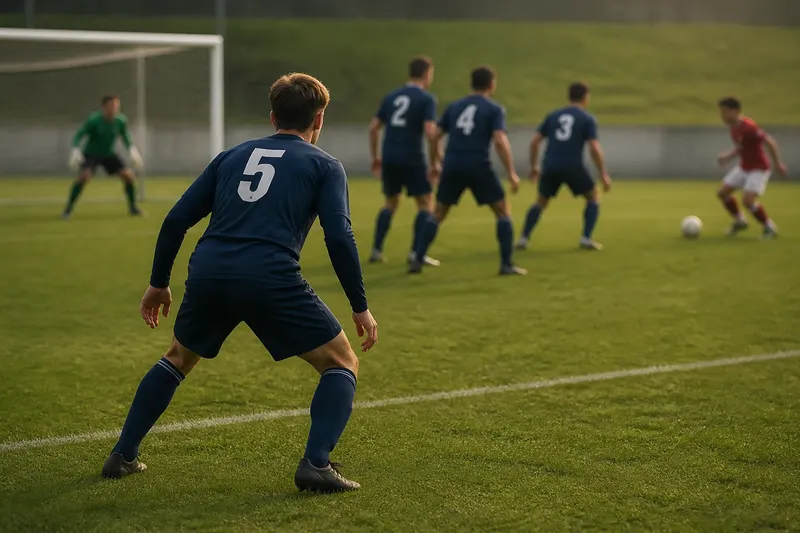
A football sweeper covers the space behind the other defenders, ready to deal with a pass or run that gets through. The role is not defined by standing in one fixed spot: the player must read the ball, the defensive line and the attackers’ movement together.
That responsibility can go wrong in several ways. The sweeper may arrive late, leave another route open or rush towards a challenge already covered by a teammate. Each problem calls for a clear decision about which space to protect and who acts first.
Starting position
A sweeper who stands too deep may spot danger early but remain too far away to affect it. An opposing forward can receive a pass, turn and run towards goal before the covering defender closes the space. The problem may begin with the sweeper’s starting position rather than a lack of speed.
The player needs enough depth to cover a ball played behind the line, without leaving the rest of the defence unsupported. The right position depends on the team’s shape, the ball’s location and how quickly the defenders can move together. Ask: if a teammate challenges now and the opponent slips past, can the sweeper reach the next dangerous space in time to influence the attack?
In training, move the defensive line across as the ball shifts. The sweeper should stay behind the nearest defender while adjusting towards the likely route, rather than drifting towards the middle by habit. The aim is not to chase every attacker; it is to occupy the space most exposed by the next pass.
Say you are coaching a back line repeatedly beaten by passes down its right side. Imagine the sweeper starts behind the centre while the ball is on the right. Ask the player to shade towards that side as the ball travels, while keeping a clear route across to the centre. The expected result is a closer position against the likely run without abandoning the central space.
Covering other routes
Covering one side can expose another. This happens when a sweeper follows the ball instead of reading the threats around it. The player may end up close to a teammate already engaged, while an unmarked opponent occupies the space behind the far defender.
Before moving, scan the ball, the nearest forward and the space behind the line. Update the position as play develops. The sweeper is not a shadow of the ball: the job is to stay connected to the defence while remaining able to cover the most dangerous route.
Communication makes that choice clear. Short calls such as “hold”, “left shoulder” or “I’ve got the run” tell a defender whether to step forward, stay in place or leave the covering player to track an attacker. Name the immediate task; a long explanation is little use while the ball is moving.
Teams can agree on a simple priority: protect the route towards goal first, then cover the next likely pass. That does not mean ignoring a player wide of the action. It gives the sweeper a basis for choosing between simultaneous threats rather than reacting to whichever is nearest.
Choosing who challenges
When the defender and sweeper both rush towards the ball-carrier, the attacker may pass between them or release the ball into the space they leave. This often starts with uncertainty: the defender does not know whether the sweeper is covering, while the sweeper assumes the defender needs help.
Agree on responsibilities before the match. The nearest defender normally decides whether to challenge, while the sweeper protects the space behind. If the defender is bypassed or cannot reach the ball, the covering player can step in. The precise trigger can vary, but teammates should recognise it from a call, gesture or agreed cue.
During a drill, pause play after the first defender approaches the attacker. Ask the sweeper to hold position and identify the open route. Replay the situation, allowing the sweeper to move only when the defender is bypassed or the ball is played into the space behind. The contrast helps players distinguish challenging from covering.
“Stay behind” does not mean remaining passive when a loose ball or exposed run demands action. The sweeper should intervene when doing so protects the team, rather than joining a challenge a teammate already controls.
Keeping the line connected
A sweeper can cover effectively only if the defenders ahead remain connected. If one defender drops well behind the others, an opponent may be kept onside while the rest of the line moves forward. If one steps up alone, a channel can open beside them. The sweeper then faces several threats without a clear line to support.
When the line becomes uneven, call for the immediate correction rather than trying to repair the whole shape alone. A clear “step” or “drop” can help teammates move together. The sweeper must also adjust to the line’s actual position: standing behind where the defence ought to be does not protect where it is.
In association football, the sweeper’s position alone does not determine whether an attacker is onside. The relevant positions of the attackers and defenders are assessed when a teammate plays the ball, subject to the offside law’s conditions and exceptions. Legal positioning and covering responsibility are related, but they are distinct jobs.
When should a sweeper step in?
What is a sweeper responsible for?
The sweeper covers space behind the other defenders and responds when an attacker gets through or a pass threatens that space. Scanning and communicating are part of the role, not just waiting near the goal.
Should the sweeper always stay behind the line?
No. The player may move across or step forward when the ball and defensive shape make that the safer choice. The essential point is to avoid leaving the team without cover for a more dangerous route.
How is a sweeper different from a goalkeeper?
A sweeper is an outfield defender who works in front of the goalkeeper and supports the defensive line. A goalkeeper protects the goal and has separate responsibilities, so the two players need to communicate about loose balls and runs into the space between them.
Does every team use a sweeper?
No. A coach may assign one player to cover behind the line, or ask the defenders to share that responsibility through their positioning. The name matters less than knowing who watches the space when a teammate moves to challenge.
Clear calls
Even a well-positioned sweeper can be ineffective if teammates cannot tell what the player is doing. A defender may hold back, expecting cover, while the sweeper assumes that defender will challenge. That pause gives an opponent time to turn, pass or run at the defence.
Agree on a small set of calls and use them consistently. “Cover” can indicate that the sweeper is taking responsibility behind; “step” can ask the line to move forward together; “drop” can warn that a run threatens the space behind. Avoid using several words for the same action. Familiar calls are easier to process under pressure.
Practise communication while the ball moves, not only in a stationary formation. A coach can send the ball from one side to another and ask the defensive group to adjust, with the sweeper calling the threat and the line responding. The useful sign is coordinated decisions before the attacker reaches the exposed space, not loudness by itself.
Spotting the role
To recognise a sweeper’s function, watch when a teammate leaves the line to challenge. Does someone remain behind, positioned to deal with a pass or run through the gap? Then watch what happens when the ball shifts to the opposite side. A covering player moves with the danger while staying connected to the defence, rather than simply trailing the ball.
The role may be less obvious when a team keeps possession or defends far from its own goal. It becomes clearer during a transition, after a lost ball or when an opponent tries to break beyond the defenders. Focus on the player’s relationship to the line and the uncovered space; the deepest defender is not automatically acting as a sweeper.
The sweeper’s position behind the line is best judged by the space it protects. If the player can cover a breakthrough, guide teammates and prevent an open route to goal, the role is serving its purpose. Like a doorstop holding a door before it swings shut, the sweeper may be most valuable in danger that never gets through.