Why a Tennis Tie-Break Changes the Shape of a Set
A tennis tie-break gives a level set a distinct finish. Learn how its format shifts attention, serving choices and tactical trade-offs for players and spectators.
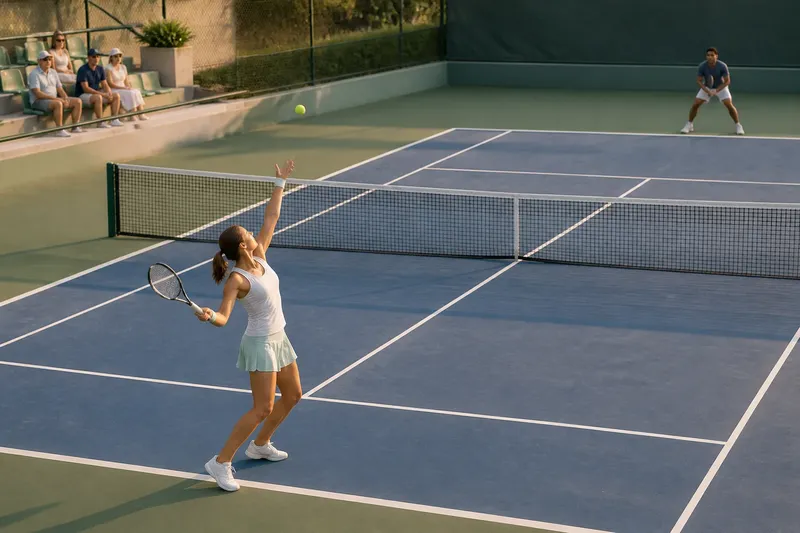
A tennis tie-break turns a level set into a distinct closing phase. In an invented club match, Mara and Dev arrive at the tie-break after trading games on an outdoor hard court; the format now asks them to settle the set through a separate point sequence.
The change is more than a different number on the scoreboard. Players still serve, return and build rallies, but their decisions sit inside a clearly bounded finish. For spectators, that makes the score easier to follow while putting tactical choices under a brighter lamp.
The set reaches its boundary
Before the tie-break, Mara and Dev have been trying to win games and reach the set’s required position under the event rules. Neither has created enough separation to close it in the ordinary way. The tie-break begins because that competition’s format calls for one at this point.
That detail matters: tie-break rules are not identical in every event or at every stage of a tournament. The competition’s regulations specify when one is used and how it proceeds. Players and spectators should check those rules rather than assume that one format applies everywhere.
The tie-break does not erase the earlier games. Dev’s reliable serving helped keep the set level; Mara’s returns created pressure. The closing phase gives the set a defined resolution, while those earlier patterns still help explain what may happen next.
A different point sequence
In an ordinary game, attention often follows service holds and chances to break. In a tie-break, the point score itself becomes the main guide. The scoreboard is like a kitchen timer: it marks a distinct phase, but it cannot tell you who is controlling the rallies.
Service order and court changes follow the competition’s rules for that tie-break. Those procedures may differ by format, so a viewer should not infer them from a familiar match. What remains easy to observe is the tactical task: the server wants to make the return difficult, while the receiver wants to keep the ball in play and create a useful next shot.
Imagine Dev receives a wide serve and is pulled towards the sideline. He chooses a controlled return through the middle rather than attempting a winner down the line. The ball comes back safely and gives Mara less room to attack; Dev has traded an immediate attempt to finish for a chance to contest the next shot.
Pressure and choices
A mistake can feel especially costly when the set is close to its finish. That feeling does not decide what happens next: the player still has to serve or return the following point. For a spectator, it helps to separate the score’s emotional weight from the quality of the next decision.
Suppose Mara misses an approach shot into the net. In this invented situation, she pauses, takes a breath and returns to her serving routine before the next point. The observable result is simply that she starts the next point without rushing; whether that helps her depends on the shot and the reply that follow.
Dev faces the opposite temptation after taking a lead: to play so cautiously that Mara can set her feet and attack. He instead aims his returns deep and waits for a manageable chance to move forward. Neither aggression nor caution is automatically right. The useful question is whether the choice fits the ball, court position and opponent in front of him.
Reading a tie-break?
Why do tennis matches use tie-breaks?
A tie-break gives a level set a defined route to a result when the event’s format calls for one. It provides a closing phase without making the earlier games irrelevant.
Does a tie-break decide the match?
It decides the set, not automatically the match. The match result depends on the event’s format and the sets still to be played.
Is a tie-break an ordinary game?
No. It is a distinct scoring phase with its own procedures, including service order and court changes. Check the competition rules for the format being played.
Can the tie-break winner have played worse overall?
A player can win the tie-break without controlling every part of the set or match. The result settles what the format assigns to that phase; it is not a full account of performance.
Trade-offs in view
Say Mara serves wide and Dev returns from well behind the baseline. For this invented situation, Mara sees the extra time Dev has given himself, directs her next shot towards the open court, and draws him into a difficult run. The observable result is a longer route for Dev to cover, balanced against the risk that Mara’s placement leaves the ball within reach.
That exchange shows what a tie-break makes visible: choices often exchange one advantage for another. Standing farther back may give a receiver time to handle a serve, but it can concede court position. Attacking early may take control of a rally or give the opponent an opening.
Use these observations to read the closing phase. Each item pairs something to watch with a decision and an alternative:
- Serve placement: If the serve repeatedly pulls the receiver wide, then watch for a follow-up into open space; if the receiver reaches it comfortably, then look for the server to change placement or serve direction.
- Return depth: If the return lands deep and pushes the server back, then the receiver can look for another deep ball; if it lands short, then the server may move forward and take the ball early.
- Receiver position: If the receiver stands well behind the baseline, then watch whether the server uses a shorter angle; if the receiver crowds the baseline, then a deeper serve may make the return harder to control.
- Approach shot: If a player moves forward behind a short ball, then check whether the approach leaves the opponent a passing lane; if it does, then the player may need to close towards that lane or stay back.
- Rally patience: If a player is forcing a winner from a difficult position, then watch for a safer target through the middle; if the opponent leaves an open court, then a more direct attack may make sense.
- Reset after an error: If a player rushes into the next point, then watch for a pause and a return to routine; if the player is already composed, then the next decision can focus on serve or return placement.
The invented finish
In Mara and Dev’s imagined match, Mara serves with control and draws a shorter return. She moves forward, plays into the open court and makes Dev reach. He gets the ball back, but leaves it high enough for her to finish the rally. The sequence gives Mara the set under the event’s stated format; it does not show that she controlled every earlier game.
For a spectator, the point score tells where the closing phase stands. The rallies explain how it is unfolding: notice where returns land, whether a server changes placement, and how each player responds to a short ball. A tennis tie-break is easiest to read when the score and the choices are kept in view together.